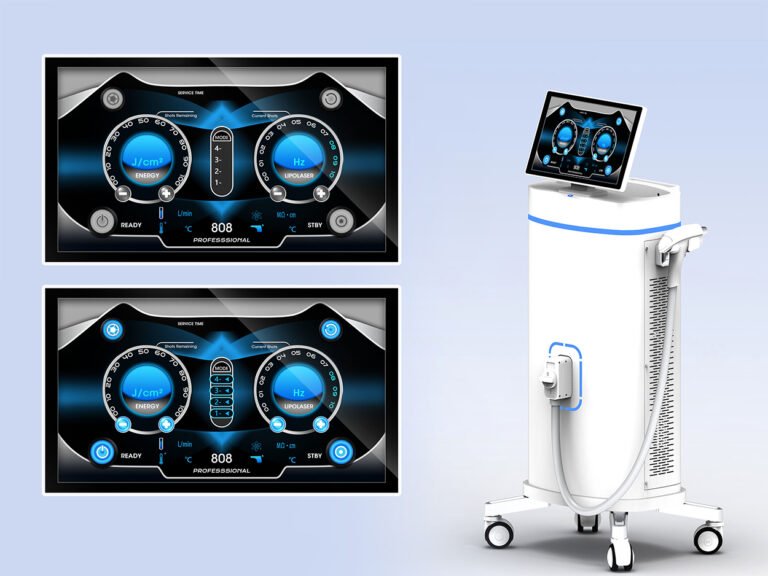
Still struggling to distinguish between PicoSure and Picosecond? This article provides an in-depth comparison of PicoSure and Picosecond lasers in terms of their principles, wavelengths, indications, and cost-effectiveness, helping you make the wisest purchasing decisions for your beauty clinic.
In the beauty equipment market, “Picosecond” is undoubtedly one of the hottest keywords in recent years. However, many beauty salon owners and clinic purchasing managers often confuse two concepts: PicoSure and Picosecond.
Many clients ask, “Are they the same?” or “Should I buy a PicoSure or another picosecond machine?”
Simply put: Picosecond is the “technology,” while PicoSure is the “brand and model.” They are closely related, but definitely not the same. As a professional beauty equipment manufacturer, today we will break down the differences between these two from the perspectives of technical parameters, treatment effects, and return on investment (ROI) to help you choose the machine best suited for your business.
Principle Origin: The Difference Between Technical Scope and Specific Implementation
To understand the difference between the two, we must first start with the principles of physics.
What is a Picosecond?
A Picosecond refers to the pulse duration of a laser beam.
- Definition: 1 picosecond equals 10^{-12} seconds. Any laser machine with a pulse width in this time range can be collectively referred to as a “picosecond laser.”
- Core Mechanism: It utilizes the photoacoustic effect rather than the traditional photothermal effect. It uses an extremely short pulse width to generate a powerful mechanical shock wave, shattering pigment particles into tiny “dust” that is then metabolized by the body.
- Market Status: The vast majority of high-performance, cost-effective professional picosecond laser machines on the market (including those produced in our factory) typically use Nd:YAG (neodymium-doped yttrium aluminum garnet) laser media.
What is PicoSure?
PicoSure is the name of a specific machine launched by Cynosure, an American company.
- Definition: It gained widespread fame as the world’s first picosecond laser device.
- Core Mechanism: It uses a 755nm Alexandrite laser medium.
- Uniqueness: It is known for its “Focus Lens,” utilizing the high absorption rate of melanin at a 755nm wavelength for treatment.
In summary, Picosecond is a broad technology category, and PicoSure is a product within this category that utilizes a specific wavelength (755nm).
Specifications Comparison: Core Parameters Comparison
As a buyer, understanding the specifications is crucial to avoiding being misled. We will compare our factory’s mainstream Nd:YAG Picosecond machines with PicoSure:
| Core Specifications | PicoSure (honeycomb picosecond laser) | Generic/Factory Picosecond (Nd:YAG picosecond) |
| Laser type | 755nm Alexandrite | Active Q-Switched Nd:YAG (Active Q-switching) |
| core wavelength | 755nm (optional for 532/1064) | 1064nm / 532nm / 1320nm / 755nm (honeycomb head) |
| Pulse width | Approximately 750ps | 300ps – 2000ps (usually shorter, with stronger explosive force) |
| Treatment depth | superficial to middle dermis | Deep dermis (1064nm has stronger penetration) |
| Skin color adaptation | Suitable for Fitzpatrick types I-III (fair skin) | Suitable for Fitzpatrick skin types I-VI (all skin tones, including dark skin tones). |
| Comfort | The heat sensation is quite noticeable (photothermal effect accounts for a slightly larger proportion). | Low heat sensation (dominated by photoacoustic effect, high comfort) |
| Peak power | high | Extremely high (Nd:YAG typically possesses even higher instantaneous energy) |
Professional Review: Nd:YAG picosecond lasers (the mainstream picosecond laser machines on the market) often have shorter pulse widths than PicoSure (meaning stronger photoacoustic effects and less thermal damage), and the 1064nm wavelength is safer for people with darker skin tones (Asians, dark-skinned people) and is less likely to cause post-inflammatory hyperpigmentation (PIH).
Application Areas: Who is the best fit for your customers?
Different technical parameters determine which skin problems they are good at solving.
A. Tattoo Removal
- PicoSure (755nm): The king of removing green, blue, and purple ink. This is advantageous if your clientele prefers colored tattoos. However, it’s less efficient than 1064nm when removing black tattoos.
- Picosecond (Nd:YAG 1064/532nm): The gold standard for removing black, gray, and red ink.
- Advantages: Considering that 90% of tattoos on the market are black or gray, Nd:YAG picosecond lasers are more practical. Furthermore, 1064nm penetrates deeper, resulting in better treatment of old, deep-seated tattoos.
B.Pigmentation and Melasma
- PicoSure: Excellent for superficial freckles and sunspots because 755nm has excellent melanin absorption. However, it requires extreme caution when treating melasma, as it can easily irritate the skin.
- Picosecond (Nd:YAG): The 1064nm wavelength is gentle and is currently the first choice for treating melasma and deep pigmentation (such as nevus of Ota and blue-brown nevus), with a much higher safety profile than 755nm.
C. Skin Rejuvenation and Anti-Aging
- Both stimulate collagen regeneration through lens technology (LIOB effect). They are equally effective, both minimizing pores and improving fine lines.
Procurement Guide: How to Choose Based on Needs
As a beauty salon owner, when choosing a machine, you should not only look at its reputation, but also at its “suitability” and “return on investment”.
Choose Based on Budget
- PicoSure: Extremely high brand premium, expensive equipment (typically over $100,000), and high consumable and maintenance costs. Long payback period.
- Factory Picosecond Machine: Our factory-manufactured high-end Nd:YAG picosecond laser uses equivalent optical components, and the price is typically only 1/5 or even less of brand-name machines. Short payback period (typically 1-3 months), making it the first choice for clinics seeking high cost-effectiveness.
Choose Based on Treatment Needs
- If you are a clinic in a predominantly white community and your clients primarily seek removal of colored tattoos (green/blue), PicoSure’s technology has a unique advantage.
- If you serve a diverse clientele (including Asian, Latino, and dark-skinned individuals), or if your main business is eyebrow removal, black tattoo removal, or melasma treatment, then the Nd:YAG Picosecond machine is the clear winner. It is safer, has a wider range of applications, and a higher margin of error.
Are Picosure and picosecond the same? The answer is no. PicoSure is a type of picosecond laser technology (alexandrite laser), while Picosecond represents the broader, more mature mainstream market (primarily Nd:YAG laser).
For most beauty clinics and distributors seeking high safety, broad applicability, and quick return on investment, choosing a high-configuration Nd:YAG Picosecond Laser Machine is often a wiser business decision than blindly pursuing brand names.
Want to know the specifications and pricing of professional-grade picosecond machines? As a source manufacturer, we offer a variety of picosecond laser equipment configurations. Please browse our product page or contact us directly for the latest information on our solutions.