This guide is written for urologists, men’s health clinics, distributors and equipment buyers. It explains how the therapy is thought to work, what the current evidence does and does not show, how linear-focused, point-focused and radial technologies differ physically, and what to verify before buying an ED shockwave machine.
One principle runs through the whole article: a device that can generate a shockwave is not, by that fact alone, a device with clinical proof for ED. Physical performance and clinical evidence are separate questions, and a credible purchasing decision needs answers to both.
1. What Is Shockwave Therapy for Erectile Dysfunction?
Shockwave therapy for ED is a non-invasive treatment in which a handheld applicator delivers low-intensity acoustic pulses to the penile shaft and crura over several sessions. It is classed as a restorative approach: unlike PDE5 inhibitors, it is not taken before sex, and it aims to improve the underlying vascular condition rather than assist a single erection.
What Is Erectile Dysfunction (ED)?
ED is the persistent inability to achieve or maintain an erection sufficient for satisfactory sexual activity. It becomes more common from about age 40 and can strongly affect quality of life for both partners. Causes may be vasculogenic (reduced blood flow, endothelial dysfunction), neurogenic, hormonal, psychogenic, drug-related or mixed. This distinction matters because the proposed mechanism of shockwave therapy is vascular, so the evidence base centers on organic, mainly vasculogenic ED.
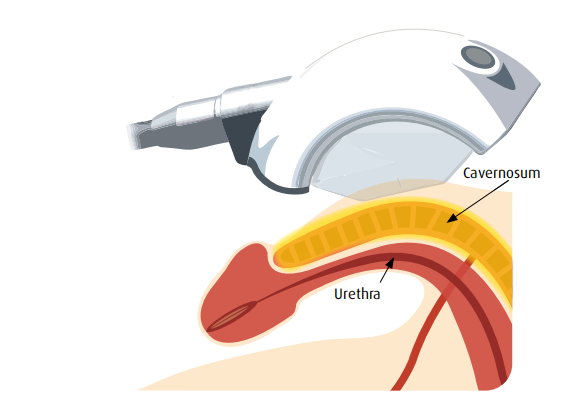
How Does Low-Intensity Shockwave Therapy Work?
The proposed mechanism is that acoustic energy triggers a mechanotransduction response in penile tissue. Laboratory and animal studies report increased capillary density (neovascularization), recruitment of progenitor cells and improved erectile responses after treatment. The working hypothesis is that new or repaired microvasculature improves blood inflow to the corpora cavernosa.
What Is the Difference Between Li-ESWT and Other Shockwave Treatments?
The word “shockwave” covers very different products. Li-ESWT for ED uses low energy flux density, typically well below the levels used in lithotripsy (kidney stone fragmentation). Orthopedic and physiotherapy devices, many of which are radial pressure wave systems, are built for tendons, plantar fasciitis and muscle trigger points. Their output, wave shape and tissue penetration differ from those of focused devices.
2. Does Shockwave Therapy for ED Really Work?
The honest answer is: possibly. Statistically detectable improvements are reported across many trials.
Which Patients May Benefit from Shockwave Therapy?
The trials mostly enrolled men with mild to moderate organic, usually vasculogenic, ED. The European Association of Urology guideline allows Li-ESWT for mild organic ED or for men who respond poorly to PDE5 inhibitors, with a weak strength of recommendation. The American Urological Association has described it as investigational. Patients with psychogenic ED, or ED following radical prostatectomy or kidney transplant, were excluded from the Cochrane analysis, so the review cannot speak to them.
3. Types of Shockwave Technology for ED
We describe each along five dimensions: how the wave is generated, how energy is distributed in space, the geometry of the focal zone, the depth of the target tissue, and the clinical evidence for ED.
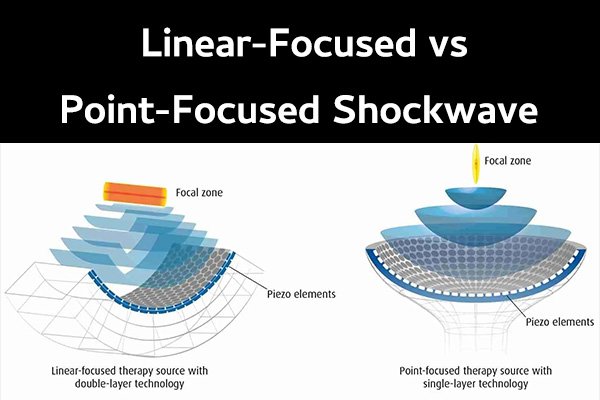
A note on terminology. “Linear-focused” and “point-focused” are not universally standardized industry categories. In this article, they describe focal-zone geometry as defined in our own device documentation: a linear-focused applicator forms an elongated focal zone from a concave array of piezoelectric elements, while a point-focused applicator converges its elements on a single geometric focal point. Whichever manufacturer a buyer evaluates, the terms should be backed by measured focal-zone data, not by labels or illustrations.
Linear-Focused Shockwave Technology
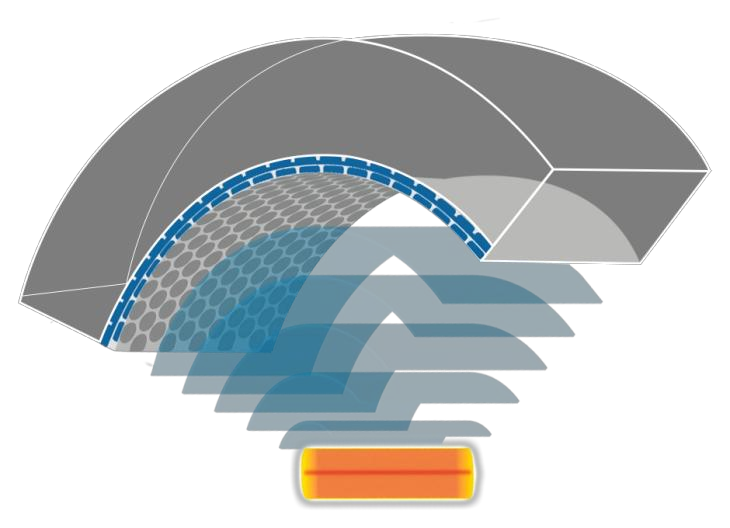
In a linear-focused design, the wave is concentrated into a focal zone that extends along one direction rather than converging on a single spot. The relevant questions are how long and how wide that zone is, at what depth it sits, and how energy is distributed along it.
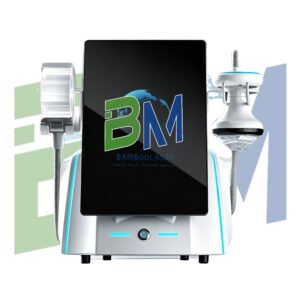
In our BA-SW37: the linear handpiece uses a concave array of piezoelectric ceramic elements, described as a double-layer design, whose wave fronts superpose into an elongated focal zone. Its stated maximum energy flux density is 0.16 mJ/mm². The geometry is intended for continuous coverage of extended structures. For ED, that means scanning along the length of the corpora cavernosa and crura with fewer repositionings and a lower risk of missed or overlapping areas.
Point-Focused Shockwave Technology
In a point-focused design, energy converges on a relatively small, localized focal region. Key characteristics are the focal depth, the axial and lateral focal dimensions, and the peak pressure and EFD achieved there.
In our BA-SW37: the point handpiece uses a single-layer concave piezoelectric transducer on which all elements converge at one geometric focal point. Its stated maximum energy flux density is 0.4 mJ/mm². Seven interchangeable silicone gel-pad probes of different thicknesses set the working depth and protect surrounding tissue.
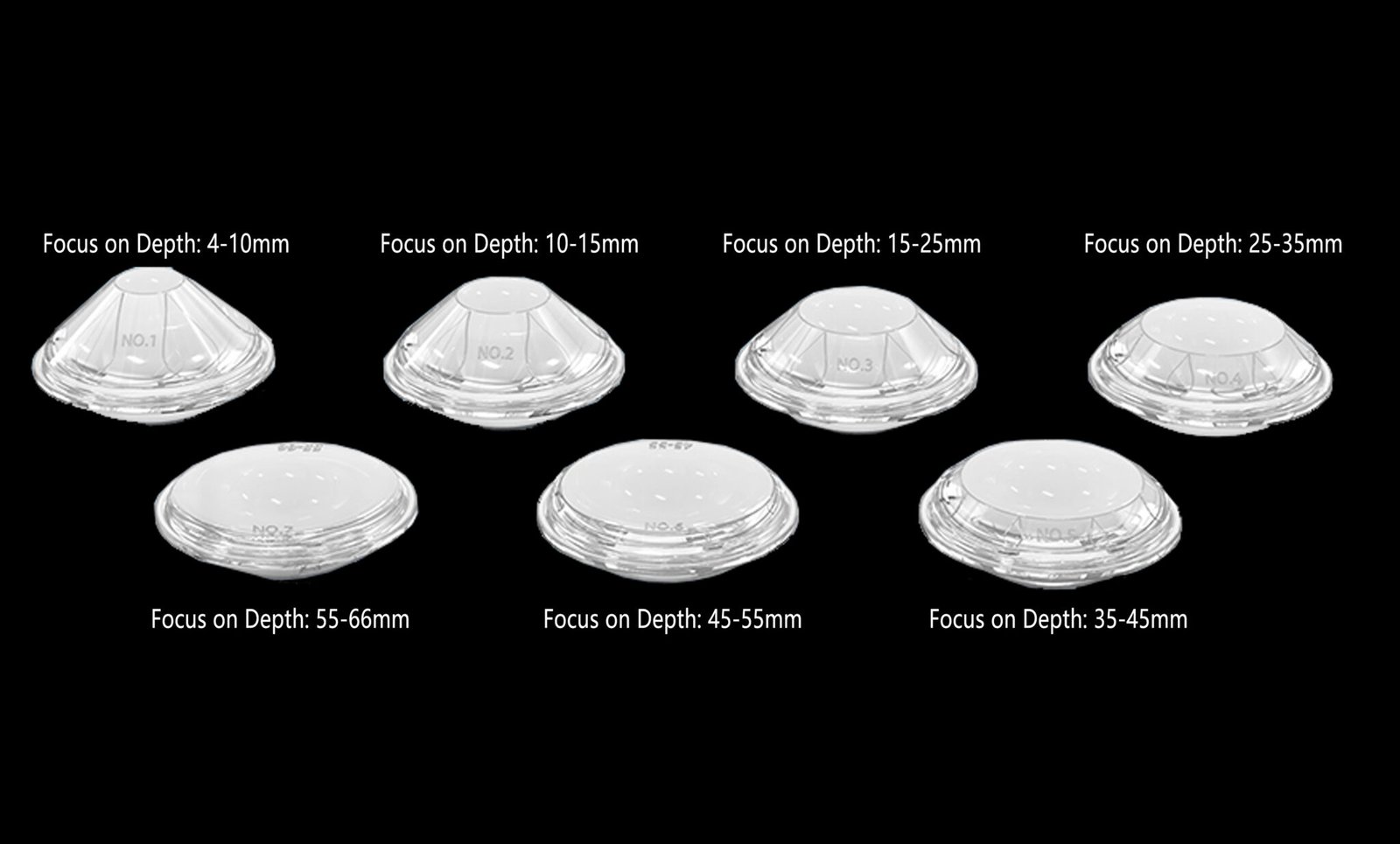
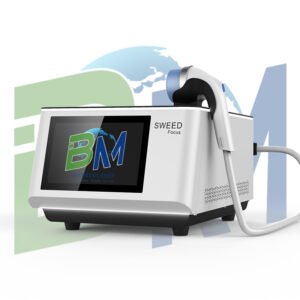
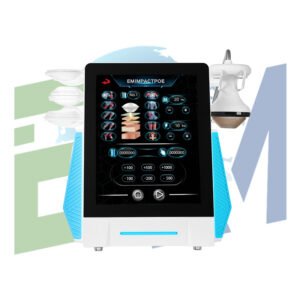
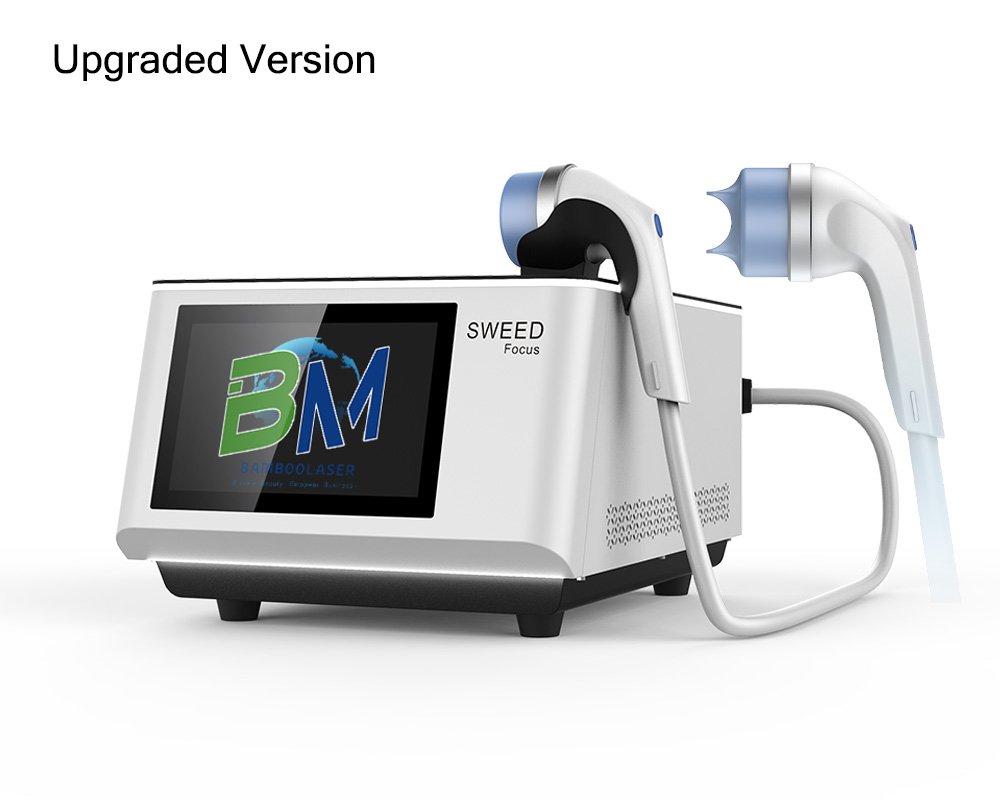
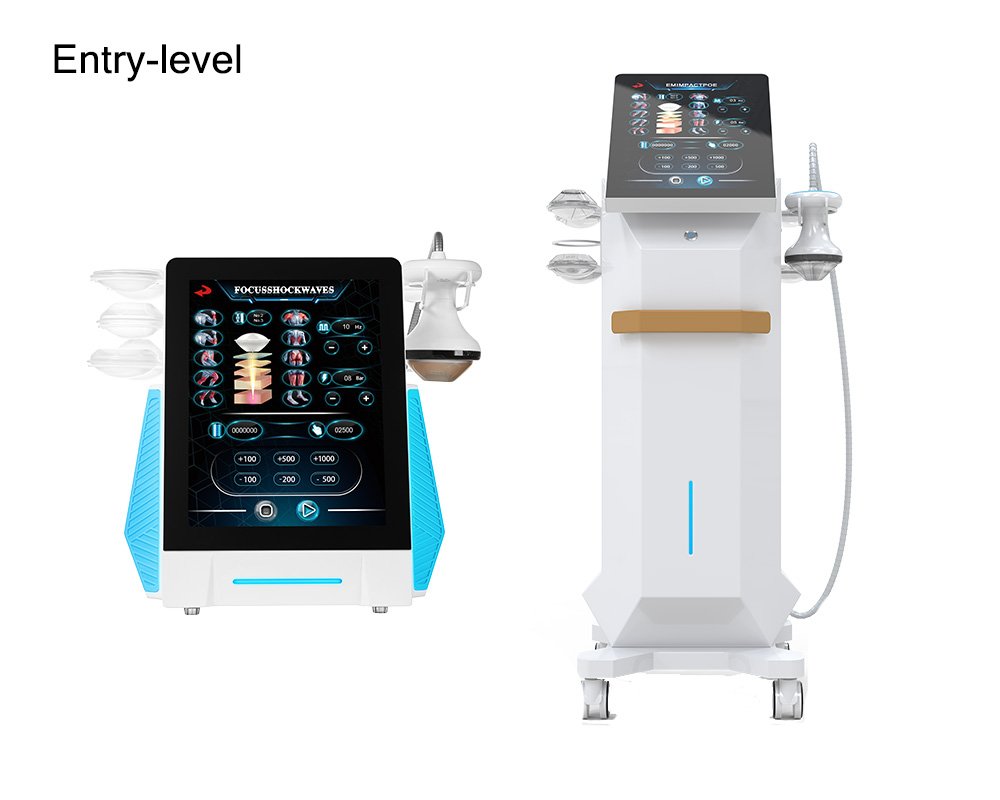
Our BA-SW30 (electromagnetic source, focal depth 1.0 to 6.6 cm) and BA-SW25 (piezoelectric source, penetration 4 to 66 mm) are also focused systems.
Radial Pressure Wave Technology
Radial devices usually generate a pressure wave by accelerating a projectile inside the handpiece, which strikes an applicator. The wave then spreads outward from the applicator tip without converging on a focus. Pressure is highest near the applicator and falls with distance into tissue. Compared with focused shockwaves, radial waves typically have lower peak pressure and a slower rise time.
Because there is no focal point, focal-zone concepts and focused-device parameters such as focal EFD do not apply in the same way. Radial and focused output figures should never be compared as if they were the same quantity.
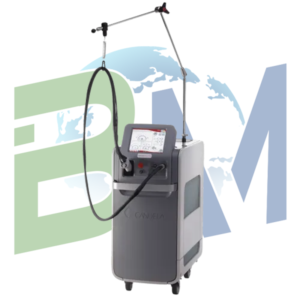
In our BA-SW36: a pneumatic (ballistic) system with seven treatment heads of 6 to 40 mm diameter in radial, focus and flat configurations, a 1 to 21 Hz frequency range and a stated applicator life of 2 million shots. We position it for orthopedic, physiotherapy and sports medicine use. It is not positioned for ED.

How Do These Three Technologies Differ?
| Dimension | Linear-focused | Point-focused | Radial pressure wave |
|---|---|---|---|
| Wave generation | Piezoelectric focusing | Piezoelectric focusing | Typically ballistic (projectile impact) |
| Energy distribution | Verified by focal-zone measurement | Verified by focal-zone measurement | Spreads outward from the applicator; strongest near the surface |
| Focal-zone geometry | Extended along one direction (verify by measurement) | Small, localized region (verify by measurement) | No focal zone; do not apply the focused definition |
| Key technical parameters | Focal dimensions, EFD, output stability | Focal dimensions, EFD, output stability | Pressure, pulse characteristics, applicable output metrics |
| Basis for selection | Physical performance, clinical data, intended use | Physical performance, clinical data, intended use | Physical performance, clinical data, intended use |
4. Focused vs. Radial Shockwave Therapy for ED
Focused low-intensity shockwave therapy has been studied far more extensively for ED than radial pressure wave therapy, and the only sham-controlled radial trial in men with ED was negative. That is the central distinction for a buyer.
Differences in Energy Distribution and Focal Depth
Focused devices converge energy into a defined zone at a chosen depth, so the energy reaching the target can be characterized and verified. Radial devices release their highest pressure at the applicator and lose it as the wave spreads, which is why surface and superficial tissues receive most of the energy.
Focused vs. Radial Shockwave Therapy for ED. Focused low-intensity shockwave therapy has been studied more extensively for erectile dysfunction than radial pressure wave therapy. However, clinical outcomes vary across devices and treatment protocols. Technology selection should therefore consider both the physical characteristics of the device and the quality of clinical evidence supporting its intended use.
5. Shockwave Therapy for ED: Treatment Protocols and Outcomes
Treatment Frequency and Number of Sessions
Published trials commonly use a course of several sessions delivered once or twice weekly over a few weeks, sometimes repeated after a rest interval. Session count, spacing and the number of treatment sites on the shaft and crura vary between studies. Clinics should follow the instructions for use of their specific device and the protocol of the trial that supports it, and should not transfer parameters between devices.
Energy Flux Density (EFD), Frequency, and Pulse Count
These three parameters define a dose.
- EFD (mJ/mm²): the energy per unit area at the focal zone. It is meaningful for focused devices only if measured under stated conditions.
- Pulse frequency (Hz): the pulse rate during treatment.
- Pulse count: the total pulses per session and per course.
EFD figures from different manufacturers are comparable only when the measurement setup, hydrophone type and reference position are the same. A published trial’s EFD is meaningful for a buyer only if the device’s own measured EFD matches it.
6. How to Choose a Shockwave Machine for ED
Shockwave Source and Applicator Design
The wave source (electromagnetic, electrohydraulic, piezoelectric or ballistic) shapes the output profile, the achievable focal geometry, the lifetime of the applicator and the cost of consumables. The Cochrane review pooled electrohydraulic, electromagnetic and piezoelectric devices but could not compare them, so no source type has demonstrated clinical superiority for ED. Ask what the applicator is rated for in total pulses, how its output behaves as it ages, and how replacement is handled.
Verifying Energy Output and Focal Characteristics
A specification sheet is a claim. A measurement report is evidence. Request:
- Focal-zone dimensions (axial and lateral) with the measurement method and standard referenced.
- Peak pressure and EFD at each energy setting, with the hydrophone and test conditions.
- Output stability data across pulse counts and between units.
- Confirmation that the figures were measured on the model being sold, not on a prototype or a different product.
For radial devices, ask which output metrics are reported and do not accept focused-device parameters as a substitute.
Questions Clinics Should Ask Manufacturers
- Which wave source and focal geometry does this device use?
- Which ED endpoints were used, and was the minimal clinically important difference reached?
- What is the applicator’s rated pulse life and the cost of replacement?
- What training, protocols, and technical support are provided, and how is output recalibrated over time?
- Which patient groups does the IFU exclude, and what does the company say about off-label use?
A manufacturer that answers these plainly, including by saying where evidence is limited, is generally a safer partner than one that promises outcomes.
7. Frequently Asked Questions About Shockwave Therapy for ED
Does Shockwave Therapy for ED Work?
It may help modestly. The Cochrane review found an improvement in erectile function versus sham.
Is Focused Shockwave Better Than Radial Shockwave for ED?
Focused shockwave has a much larger evidence base for ED. The one sham-controlled radial trial in men with ED found no difference from sham, but it tested a single protocol. No trial directly compares the two technologies, so “better” is supported by the evidence base rather than by a head-to-head result.
How Many Shockwave Sessions Are Needed?
There is no proven optimum. Trials use courses of several sessions over a few weeks, and the 2026 meta-analysis found no regimen to be clearly superior. Follow the protocol validated for the specific device.
How Long Do the Results Last?
The Cochrane review suggests improvement may persist beyond three months.
8. Explore Shockwave Technology for Medical Applications
If you are evaluating shockwave equipment for a urology or men’s health practice, the next step is to compare measured specifications and documentation, not brochures.
Explore Our Shockwave Device Technologies
We manufacture four platforms that cover the technologies discussed above. Figures are the manufacturer’s stated specifications.
| Model | Wave source | Focus type | Key stated specifications | Positioning |
|---|---|---|---|---|
| BA-SW37 dual-handle focused linear-shockwave therapy machine | Piezoelectric | Linear and point handpieces | Max EFD 0.16 mJ/mm² (linear), 0.4 mJ/mm² (point); 7 gel-pad probes on the point handpiece | Musculoskeletal and sports medicine; ED via linear coverage |
| BA-SW30 Sweed focused shockwave machine | Electromagnetic | Pointed focused | Focal depth 1.0 to 6.6 cm; 60 to 120 pulses/min; over 500,000 shots; optional ED handle | Pain, tendon and bone injuries, ED |
| BA-SW25 focused shockwave machine | Piezoelectric | Pointed focused | Penetration 4 to 66 mm; 1 to 20 Hz; strength grade 1 to 10 bar; 7 silicone pad probes; 15-inch touchscreen | Musculoskeletal conditions, ED |
| BA-SW36 pneumatic shockwave machine | Pneumatic (ballistic) | Radial, with focus and flat heads | 1 to 21 Hz; 2 million shots; 7 heads, 6 to 40 mm; 8-inch touchscreen | Orthopedics, physiotherapy, sports medicine |
Request Technical Specifications or a Product Consultation
To request technical specifications, measurement data, regulatory documentation or a quotation for the models above, use the brochure and quote request on each product page or contact our engineering team. We provide on-site or online training and after-sales support. Customization of branding, specifications and features is available, with the minimum order quantity depending on scope.
This article is for professional information and does not constitute medical advice. Treatment decisions should be made by a qualified physician.
References
- Ergun O, Kim K, Kim MH, et al. Low-intensity shockwave therapy for erectile dysfunction. Cochrane Database Syst Rev. 2025;7(7):CD013166. PubMed
- Ergun O, et al. Low-intensity shockwave therapy for erectile dysfunction: an abridged Cochrane review. BJU Int. 2026;137(6):949-957. doi:10.1111/bju.70236
- You CH, et al. A close look at the evidence on low-intensity shockwave therapy in erectile dysfunction: a systematic review and meta-analysis of randomized controlled trials. J Sex Med. 2026;23(4). Abstract
- Sandoval-Salinas C, et al. Are radial pressure waves effective for the treatment of moderate or mild to moderate erectile dysfunction? A randomized sham therapy-controlled clinical trial. J Sex Med. 2022;19(5):738-744. PubMed
- Sandoval-Salinas C, et al. Are radial pressure waves effective in treating erectile dysfunction? A systematic review of preclinical and clinical studies. Sex Med. 2021;9(4):100393. PMC
- Schoofs E, Fode M, Capogrosso P, Albersen M. Current guideline recommendations and analysis of evidence quality on low-intensity shockwave therapy for erectile dysfunction. Int J Impot Res. 2019;31:209-217. Link
- Liu JL, et al. Restorative therapies for erectile dysfunction: position statement from the Sexual Medicine Society of North America. Sex Med. 2021;9(3):100343.
- Capogrosso P, et al. Low-intensity shock wave therapy in sexual medicine: clinical recommendations from the European Society of Sexual Medicine. J Sex Med. 2019;16(10):1490-1505. PubMed
- AUA News. Shock wave therapy: is it ethical to offer and charge for erectile dysfunction or other sexual dysfunctions? March 2023. Link