If you are comparing focused shockwave therapy vs radial shockwave therapy, you are already at a critical stage of equipment selection and technical evaluation.
Both technologies are widely used in physiotherapy, pain management, and aesthetic medicine. However, they differ fundamentally in several key aspects:
- Energy delivery mechanism
- Penetration depth
- Treatment precision
- Treatment intensity
- Treatment modality
👉 In terms of treatment modality:
- Radial shockwave therapy → delivers energy in a dispersive manner, providing broad-area coverage
- Focused shockwave therapy → concentrates energy at a specific focal point, enabling targeted and precise treatment
👉 This distinction is essential:
Focused shockwave therapy offers significantly greater control and accuracy when treating deep or localized conditions.
Quick Conclusion: Focused Shockwave Therapy vs Radial
If your target patients require deep tissue treatment with high precision, and you aim to achieve higher clinical value and stronger revenue potential:
👉 Focused shockwave therapy is the superior choice
What Is Focused Shockwave Therapy?
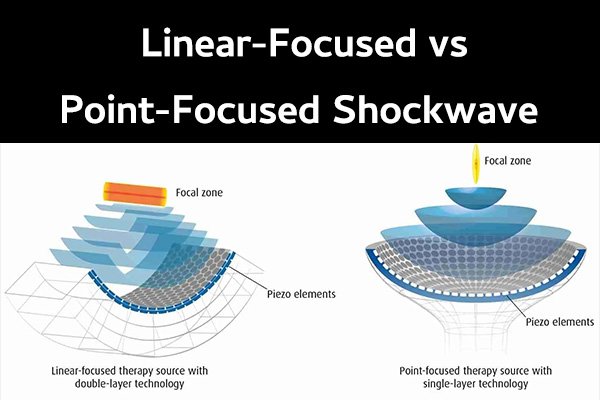
Focused shockwave therapy is an advanced treatment technology based on high-energy acoustic waves. Its defining feature is the ability to concentrate energy at a controlled focal point within the body, allowing precise therapeutic intervention.
Core Physical Mechanism
Focused shockwave systems typically rely on technologies such as:
- Electromagnetic systems
- Piezoelectric systems
The process works as follows:
- High-energy shockwaves are generated externally
- The waves are guided and shaped through reflectors or geometric focusing structures
- A focal zone is formed at a predetermined depth inside the body
- Maximum energy density is released at this focal point
👉 This allows energy to accumulate along the wave path and be delivered precisely where it is needed.
Key Characteristics
1. High-Precision Energy Targeting
Focused shockwaves can be controlled with high spatial accuracy, allowing energy to be delivered to a specific point while minimizing impact on surrounding tissues.
2. Deep Penetration Capability
Depending on system parameters, focused shockwaves can reach depths of:
👉 approximately 5 cm to 12 cm or more
This makes them suitable for:
- Deep tendon structures
- Bone attachment areas
- Vascular-related treatments (such as ED therapy)
3. High Energy Density at the Focal Zone
At the focal point, a high-pressure environment is created, which can stimulate:
- Tissue regeneration
- Improved blood circulation
- Neuromodulation responses
4. Strong Parameter Control
Operators can adjust frequency, energy levels, and penetration depth, enabling highly customized treatment protocols.
Thanks to its precision targeting, deep tissue reach, and stable energy output, focused shockwave therapy has gained widespread recognition in both physiotherapy and clinical medical applications and continues to establish a strong position in advanced treatment markets.
What Is Radial Shockwave Therapy?
Radial shockwave therapy is a treatment method that generates shockwaves mechanically or pneumatically and delivers them outward from the applicator in a radial (diverging) pattern.
Core Physical Mechanism
Key characteristics include:
- Maximum energy is delivered at the point of contact
- Energy decreases progressively as it travels through tissue
- No fixed focal point is formed
👉 Essentially, it functions as a pressure wave that spreads across superficial tissue layers.
Key Characteristics
1. Broad Treatment Coverage
Radial shockwaves can treat larger surface areas, making them suitable for widespread muscular regions.
2. Primarily Superficial Penetration
Typical penetration depth is:
👉 approximately 2 cm to 6 cm, depending on system settings
3. Even Energy Distribution
Because energy disperses outward, the stimulation is more gradual and less concentrated.
4. High Operational Flexibility
Radial systems are well-suited for:
- Multi-area treatments
- Fast clinical workflows
Radial shockwave therapy is widely established in rehabilitation and physiotherapy, particularly for muscle relaxation, fascial treatment, and superficial soft tissue conditions.
👉 It is important to note:
Focused and radial technologies are not hierarchical — they are designed for different treatment depths and clinical applications.
Focused Shockwave Therapy vs Radial: Key Comparison
| Feature | Focused Shockwave | Radial Shockwave |
|---|---|---|
| Energy Delivery | Concentrated at an internal focal point | Dispersed outward from applicator |
| Penetration Depth | ~5 cm – 12 cm+ | ~2 cm – 6 cm |
| Precision | High — enables targeted, localized treatment | Lower — broader coverage, less pinpoint control |
| Treatment Intensity | High energy density at focal zone | Gradual energy dissipation, milder stimulation |
| Indications | ED, deep tendon disorders, chronic pain | Muscle tension, fascia treatment, rehab |
| Price Range | $6,000 – $20,000+ | $2,000 – $6,000 |
Understanding Penetration Depth Differences
Shockwave propagation in the human body is influenced by:
- Tissue density
- Acoustic impedance
- Energy attenuation
Focused shockwave systems concentrate energy at depth through focal mechanisms, while radial systems dissipate energy as it travels.
👉 This leads to fundamentally different therapeutic layers and outcomes.
Effectiveness: Mechanism-Driven Differences
The therapeutic effects of shockwave treatment are based on:
- Mechanotransduction
- Microcirculation improvement
- Tissue regeneration stimulation
Focused shockwave therapy:
👉 Triggers stronger biological responses at targeted sites
Radial shockwave therapy:
👉 Supports broader functional recovery and muscle relaxation
Clinical Applications
Focused Shockwave Therapy is suitable for:
- Deep tissue injuries
- Chronic and complex pain conditions
- Erectile dysfunction (ED) treatment
- Precision-targeted therapies
Radial Shockwave Therapy is suitable for:
- Muscle relaxation
- Fascial release
- Sports rehabilitation
- Superficial soft tissue conditions
👉 These technologies are complementary rather than interchangeable.
Price Comparison & Cost Structure
Focused Shockwave Machine Price:
👉 $6,000 – $20,000+
Radial Shockwave Machine Price:
👉 $2,000 – $6,000
Price differences are mainly driven by:
- System complexity
- Energy output capability
- Precision control systems
ROI (Return on Investment)
For clinics and medical businesses:
Focused Shockwave:
- Enables high-value treatments
- Higher per-session pricing
- Faster ROI
Radial Shockwave:
- Suitable for basic services
- Lower treatment pricing
How to Choose the Right Shockwave Technology?
Consider the following:
- Do you need deep tissue treatment?
- Is high precision required?
- What is your target patient group?
- What is your budget range?
Recommended Focused Shockwave Machine
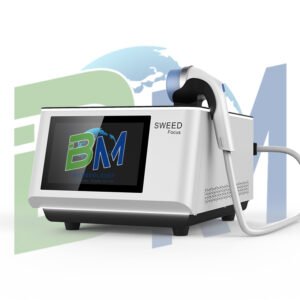
👉 BA-SW30 Sweed Focus Shockwave Therapy Machine
Key Advantages:
- High-energy output
- Deep penetration capability
- Stable performance
- OEM customization support
FAQs
Is focused shockwave always better?
Not necessarily — it depends on the treatment purpose and clinical needs.
Can radial shockwave replace focused shockwave?
No, especially for deep tissue applications.
How should I choose?
Based on your treatment goals and target patients.
Final Verdict
Focused and radial shockwave therapies represent two different technological approaches:
- Focused → deep, precise, targeted
- Radial → superficial, broad, distributed
👉 The key to choosing the right system is not which is “better,” but which is better suited to your clinical and business objectives.
🔵 Get a Quote Today
If you are looking for:
- Factory-direct pricing
- High-performance equipment
- OEM customization options
👉 Contact us now to receive:
- Latest price list
- Product catalog
- Tailored solutions